PAT Testing (Portable Appliance Testing)
Portable Appliance Testing for homes and businesses. Visual inspection and electrical safety tests on all portable equipment. Qualified and insured.
Get a quote

PAT Testing (Portable Appliance Testing)
Qualified electrician
Same-day service
Most jobs matched within hours.
Upfront pricing
Clear quotes before work starts.
Qualified pros
Credentials shown on each profile.
Pay securely
Quote, payment, and receipt stay on the job page.
How it works
Appliance inventory
The tester creates a list of all portable and movable electrical appliances on the premises. This includes anything with a plug — kettles, computers, extension leads, power tools, phone chargers, and portable heaters. Fixed appliances (cookers, immersion heaters) are excluded as they are covered by the EICR.
Visual inspection
Each appliance is visually checked for damage to the cable, plug, casing, and any guards or covers. The tester looks for signs of overheating, exposed wires, incorrect fuse ratings, non-standard repairs, and missing screws or covers. Around 90% of faults can be detected visually.
Electrical testing
Using a calibrated PAT tester, the engineer performs earth continuity testing (Class I only), insulation resistance testing, and where applicable, a substitute or touch current leakage test. The specific tests depend on the appliance class and type.
Pass/fail and labelling
Each appliance is marked as pass or fail based on the combined visual and electrical test results. Passed appliances receive a dated PAT label showing the test date and the tester's details. Failed appliances are labelled as failed and should be taken out of service immediately.
Documentation and reporting
A formal register is produced listing every appliance tested, its location, test results, and pass/fail status. This register is your evidence of compliance and should be kept on file. The tester recommends a retest interval for each appliance or category of appliance.
What's included
What's involved
PAT testing (Portable Appliance Testing) is the routine inspection and testing of electrical appliances to ensure they are safe to use. It involves a visual inspection of the appliance, plug, and cable, followed by electrical tests using a dedicated PAT tester. The tests vary depending on whether the appliance is Class I (earthed, with a metal casing) or Class II (double insulated). Results are recorded, and each appliance that passes receives a dated label. PAT testing is not a specific legal requirement in its own right, but it is the accepted method of meeting your duty under the Electricity at Work Regulations 1989 to maintain electrical equipment in a safe condition.
Employers have a legal duty under the Electricity at Work Regulations 1989 to ensure all electrical equipment used by employees is maintained in a safe condition. Landlords who provide electrical appliances must ensure they are safe at the start of each tenancy. PAT testing is the recognised, practical way to demonstrate compliance. Without it, you cannot prove your appliances are safe — and in the event of an incident, you could face prosecution, insurance claims, and personal liability.
Get a personalised quote
Typical cost: £1–£5per appliance
Every job is different — pricing depends on your property, location, and specific requirements. Describe what you need and a qualified electrician will quote you directly.
How long does it take?
Varies by number of appliances. A typical office with 30-50 appliances takes 2-3 hours. A small rental property with 10-15 supplied appliances takes about 1 hour. Large commercial premises can take a full day or more.
Regulations & safety
Safety notice
PAT testing does not require a qualified electrician by law, but the tester must be competent to carry out the work. For anything beyond basic visual checks, use a trained PAT tester or electrician with the appropriate equipment.
A failed appliance must be taken out of service immediately. Do not attempt to repair it and put it back into use without retesting. Cut the plug off if the appliance is being disposed of to prevent reuse.
Extension leads and multiway adaptors are the most commonly failed items. Overloaded or daisy-chained extension leads are a significant fire risk. Replace any damaged or overloaded leads immediately.
Electricity at Work Regulations 1989
Requires employers to maintain electrical systems and equipment in a safe condition so as to prevent danger. PAT testing is the accepted practical method of demonstrating compliance for portable appliances.
IET Code of Practice for In-Service Inspection and Testing of Electrical Equipment (5th Edition)
The industry standard guide for PAT testing. It sets out the recommended testing procedures, pass/fail criteria, and retest frequencies for different categories of equipment and environments.
Health and Safety at Work Act 1974
Places a general duty on employers to ensure the health, safety, and welfare of employees so far as is reasonably practicable. Safe electrical equipment is part of this duty.
Electrical Equipment (Safety) Regulations 2016
Requires that electrical equipment placed on the market or supplied for use is safe. Landlords providing appliances to tenants must ensure they meet this standard.
What to expect
Having issues with your existing installation?
Already have a pat testing (portable appliance testing) and having issues? Check our troubleshooting guides.
Frequently asked questions
We’re happy to answer all your questions.
Is PAT testing a legal requirement?
There is no specific law called 'the PAT testing law'. However, the Electricity at Work Regulations 1989 require employers to maintain electrical equipment in a safe condition, and PAT testing is the recognised method of doing this. For landlords, providing unsafe appliances breaches multiple housing and safety regulations. In practice, PAT testing is the standard that insurers, local authorities, and courts expect to see.
How often should PAT testing be done?
It depends on the equipment and environment. The IET Code of Practice recommends: IT equipment in offices every 4 years, portable appliances in offices every 2 years, equipment used by the public annually, and power tools on construction sites every 3 months. Your PAT tester will recommend appropriate intervals.
Can I do my own PAT testing?
Technically, yes — there is no legal requirement for a specific qualification. However, you must be competent to carry out the tests and interpret the results. For formal compliance records that will satisfy insurers and enforcement bodies, it is strongly advisable to use a trained professional with calibrated equipment.
What is the difference between Class I and Class II appliances?
Class I appliances have a metal casing and rely on an earth connection for safety (kettles, toasters, desktop computers). Class II appliances are double insulated and do not need an earth connection — they are marked with a double-square symbol (phone chargers, most power tools, TVs). The PAT tests differ: Class I appliances require an earth continuity test, Class II do not.
Do I need PAT testing for a rented house?
If you are a landlord providing electrical appliances as part of a furnished or part-furnished tenancy, those appliances should be PAT tested before the start of each new tenancy. The fixed installation (wiring, sockets, consumer unit) is covered by the EICR, but any supplied portable appliances are your responsibility to maintain in a safe condition.
What happens if an appliance fails?
The appliance is labelled as failed and should be removed from service immediately. Do not continue to use it. The tester will note the reason for failure in the register. Common failures include damaged cable insulation, high earth resistance, and poor insulation resistance. Many failed appliances can be repaired and retested, but it is often cheaper to replace consumer appliances.
Other testing & certificates services
Browse more services in the testing & certificates category.
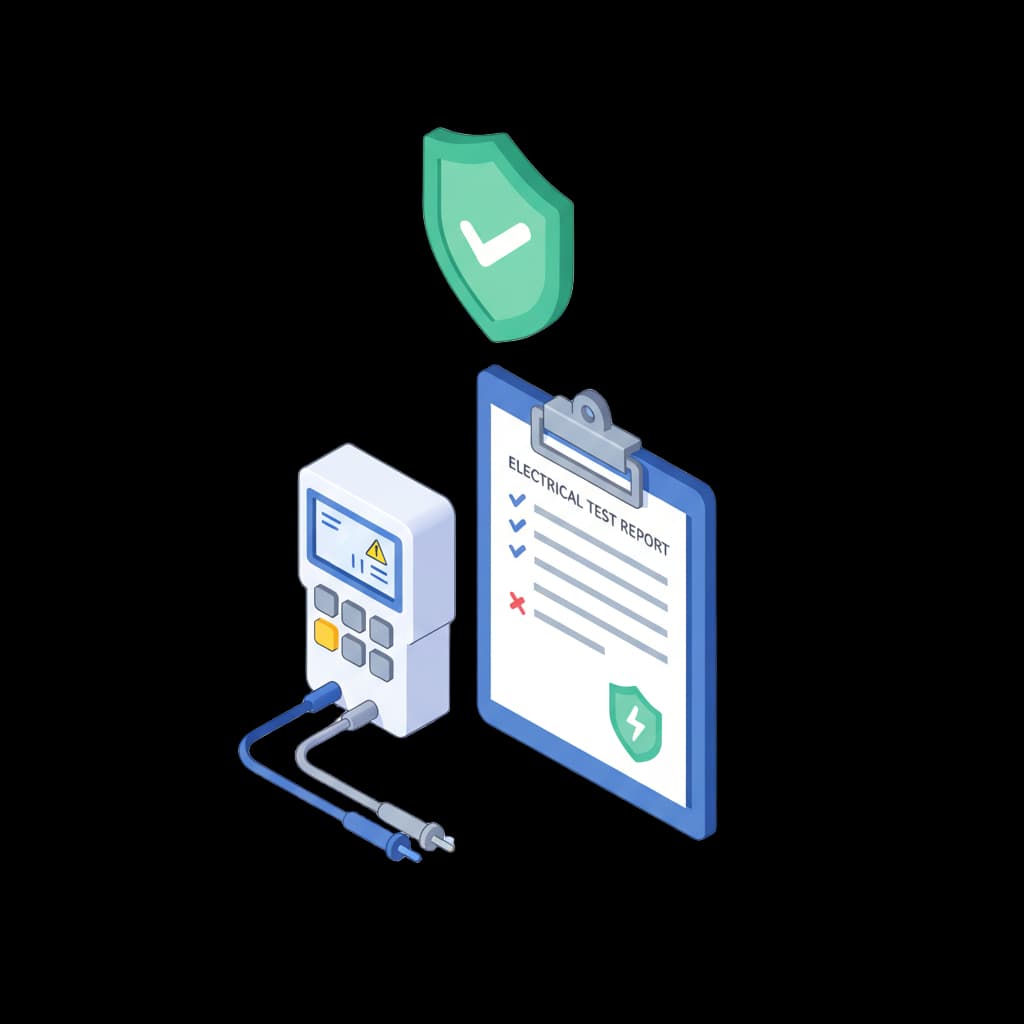
EICR (Electrical Installation Condition Report)
Professional EICR inspection by qualified electricians. Full condition report with classification codes. Qualified and insured.

Landlord Electrical Certificate
Legally required electrical safety inspection for rental properties. Compliant EICR with landlord-specific guidance. Qualified and insured.

Pre-Purchase Electrical Survey
Electrical survey before buying a property. Full inspection of wiring, consumer unit, and safety systems. Qualified and insured.

Fire Alarm Testing
Professional fire alarm testing and certification. BS 5839 compliant inspection, testing, and servicing for domestic and commercial systems. Qualified and insured.

Emergency Lighting Installation & Testing
Professional emergency lighting installation and testing by qualified electricians. Maintained and non-maintained systems for commercial premises and HMOs. BS 5266 compliant. Qualified and insured.
Find pat testing (portable appliance testing) near you
Browse qualified electricians for pat testing (portable appliance testing) by London borough.
Need pat testing (portable appliance testing)?
Describe what you need to Sparky and we'll match you with a qualified electrician near you.
Start AI reportFind a Local Electrician
Need a qualified electrician? Browse all London electricians or find one in a borough near you.